Five items in a wardrobe repay a single considered purchase for a decade: the rest of the closet runs on honest replacement. The short list, argued — leather shoes with stitched construction, a wool overcoat, a dark denim jean, a leather belt, and a quality white shirt — chosen because each combines long wear cycles, repairability, and styles that stopped changing years ago. Market example prices verified at last check, March 2026; if you buy through links in our shopping guides, Zebule may earn a commission at no cost to you.
What makes an item a buy-once candidate?
Three properties in combination. Repairability: it can be resoled, re-tailored, or re-hemmed rather than replaced. Style stability: its silhouette has not meaningfully changed in twenty years, so it cannot date. And wear-cycle length: it is worn enough to justify quality but laundered gently enough that quality survives. Items failing any leg drop off the list — which is why the buy-once list is short and why "buy it for life" marketing around socks and t-shirts is nonsense.
The five, argued
- Stitched leather shoes, around $200 at last check. The anchor purchase. A Blake-stitched or Goodyear-welted pair is resoleable two to three times or indefinitely; a cemented pair is not repairable at all. One $200 pair with two resoles at roughly $60 each beats three or four disposable pairs by year five, in cost and in how it looks at year five.
- A wool overcoat, around $350 at last check. Worn daily through winter, dry-cleaned once a season. Wool-cashmere blend or heavy wool in a single-breasted, knee-length cut — a silhouette that has been correct since the 1950s. The coat a good tailor re-lines at year eight is cheaper per winter than any coat replaced at year three.
- Dark straight jeans in rigid denim, around $150 at last check. The laundering argument again: raw and rope-dyed denim is washed rarely, so the fabric premium survives. Indigo that fades in streaks instead of graying out is the visible dividend.
- A full-grain leather belt, around $90 at last check. The smallest item with the largest cheap-buys penalty: bonded leather belts crack at the hole line within two years, while full grain with a solid brass buckle develops a patina and outlives the trousers it was bought for.
- The white shirt in proper poplin, around $120 at last check. The one laundered item on the list, and it qualifies because laundering is gentle — cold wash, hang dry — and construction is verifiable in-store. Fused collars are the failure point; stitched ones hold for years.
Related stories: Five Winter Accessories That Outlast the Trends · The Trench at $80, $300, and $900: What Changes.
The durability arithmetic
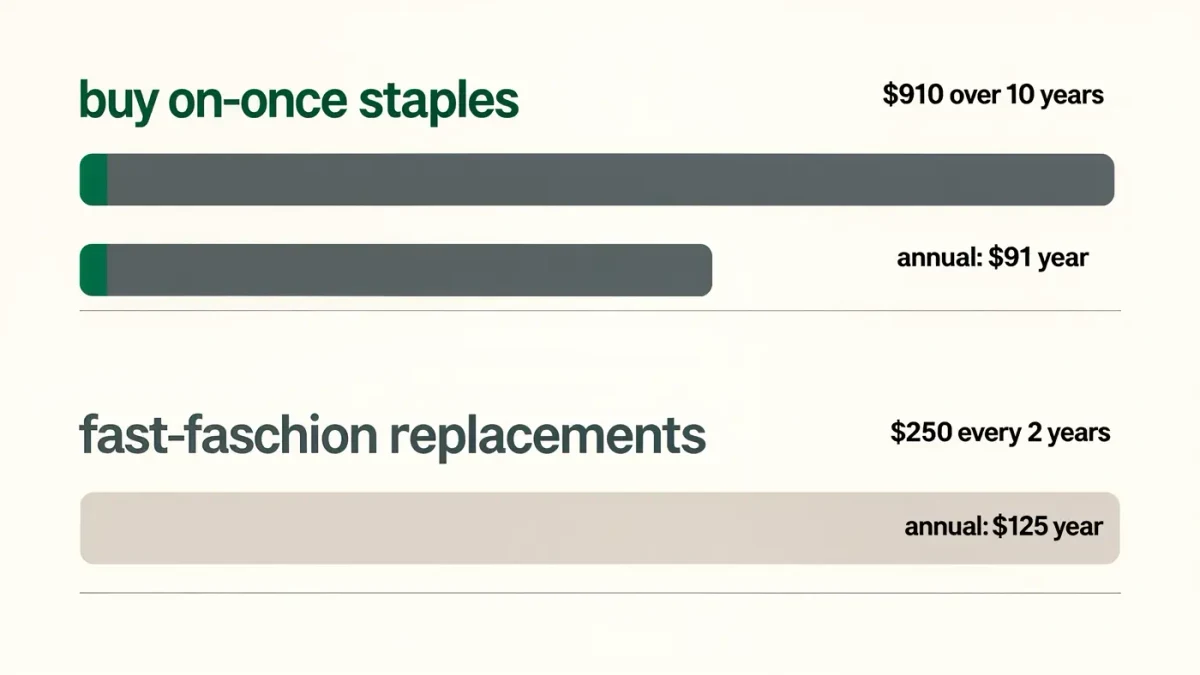
Run the list through cost-per-year rather than cost-per-item. The five picks above total roughly $910 at last check, and none should need replacement inside five to ten years: that is on the order of $90 to $180 per year for the skeleton of a wardrobe. The same slots bought at fast-fashion prices — around $250 total — need replacing every one to two years, converge on similar annual spend, and look progressively worse between purchases. Buy-once is not anti-budget; it is the budget, amortized honestly.
What disqualifies an item from the list?
Laundering exposure and trend exposure. The drum decides the lifespan of t-shirts, underwear, and socks regardless of price, so premium versions there are donations in waiting. And anything whose silhouette is current — this year's barrel leg, this year's cropped everything — fails the style-stability test by definition; trend items are supposed to be temporary, so buy them cheaply on purpose.
How do you verify quality before paying?
- Shoes: flex the sole and look for the stitch line inside the heel; no stitching, no resole.
- Overcoat: check the lining is a real fabric set in with room at the back, not a sprayed shell.
- Jeans: read the weight in ounces on the care tag — 12 ounces and up holds a straight line.
- Belt: bend the strap back on itself; bonded leather cracks at the fold immediately.
- Shirt: pinch the collar between two fingers — stiff paper means fusing, gentle roll means stitching.
When does buying once become an excuse?
Two distortions deserve naming, because the buy-once idea fails most often at its edges. The first is using durability to justify a purchase the calendar cannot support: a $350 overcoat for a climate with three cold weeks, or a second stitched-shoe pair when the first does the job — permanence does not change the wear-frequency arithmetic, and an unworn staple is expensive storage regardless of construction. The second is buying-once as procrastination: waiting to afford the perfect version while the rotation runs on nothing, when the honest move is a decent mid-tier placeholder now and the upgrade when the budget lands. Buy-once is a claim about a decade, and a decade is only verifiable one season at a time — which is also its practical test. Before any item joins the list, ask what it replaces, how often the calendar says it will be worn, and whether a repair network exists for it in your city: a cobblable shoe in a town without a cobbler is only half bought. Pass those three and the purchase stops being a splurge with good marketing and becomes infrastructure — the small set of things a wardrobe stands on while everything above it changes freely.
The thesis: buy once where repair, style stability, and gentle laundering meet — the five items above — and let everything seasonal be bought casually, replaced freely, and never apologized for.
Sources for this piece include Reuters' retail and consumer coverage.